Taiwanese cold noodles sound simple until you try to shop for the sauce in Japan. Sesame paste, peanut butter and black vinegar all have nearby Japanese options, but none of them behave exactly like the Taiwanese ingredients on their own.
The most reliable Japan version starts with three things: 白ねりごま or 練りごま for sesame body, unsweetened peanut butter for the familiar Taiwanese thickness, and 黒酢 for the black-vinegar acidity. Once those are balanced with soy sauce, sugar, garlic and cold water, the sauce becomes much closer to the cold noodles from a Taiwanese breakfast shop or convenience store.
This is not a mechanical copy of Japanese gomadare. It is a practical Taiwanese sesame sauce built from ingredients you can actually buy in Japan.
Quick answer: the best Japan substitute combination
For Taiwanese cold noodle sesame sauce in Japan, I would start with this combination:
- White nerigoma / nerigoma (白ねりごま/練りごま): the main sesame body and thickness.
- Unsweetened peanut butter: the small peanut note that makes the sauce feel more Taiwanese.
- Japanese black vinegar (黒酢): the closest easy substitute for Taiwanese black vinegar in this sauce.
- Soy sauce, sugar, garlic and cold water: the seasoning and texture controls.
If you find YOUKI sesame paste (芝麻醤/チーマージャン), you can use it instead of plain nerigoma. If you are shopping only at a normal Japanese supermarket, white nerigoma is enough to make a good version.
If you are deciding which vinegar to keep at home for Taiwanese cooking, see the English guide to choosing vinegar substitutes in Japan.
Ingredients you can buy in Japan
| Taiwanese ingredient | Japan substitute | How to use it |
|---|---|---|
| Sesame paste | White nerigoma / nerigoma | Best everyday choice. It gives body, but you need to season it yourself. |
| Sesame paste | YOUKI 芝麻醤/チーマージャン | Closest Chinese-style option when available. |
| Peanut aroma | Unsweetened peanut butter, or KALDI Skippy Chunk | Adds the familiar Taiwanese thickness. Reduce sugar if the peanut butter is already sweet. |
| Taiwanese black vinegar | Japanese 黒酢 | Good practical substitute; the aroma is cleaner and less heavy than Taiwanese black vinegar. |
| Black vinegar backup | Rice vinegar plus a little soy sauce and sugar | Emergency option only. Add gradually because the acidity can feel sharper. |
| Garlic paste | Fresh garlic or にんにくチューブ | Fresh grated garlic tastes closest; tube garlic is convenient but softer. |
I often use KALDI Skippy Chunk peanut butter for this. The tiny peanut bits actually help the sauce feel closer to Taiwanese sesame sauce. Because it is not a completely neutral peanut paste, start with less sugar and adjust at the end.
Taiwanese cold noodle sauce ratio
This ratio makes enough sauce for about 2 servings of cold noodles.
| Ingredient | Amount | Purpose |
|---|---|---|
| White nerigoma / nerigoma | 2 tbsp | Main sesame aroma and body. |
| Unsweetened peanut butter | 1 tbsp | Peanut thickness and Taiwanese-style roundness. |
| Soy sauce | 1.5 tbsp | Salt and savory depth. |
| Black vinegar (黒酢) | 1 tbsp | Acidity and black-vinegar finish. |
| Sugar | 1 to 1.5 tsp | Balances garlic and vinegar. |
| Grated garlic | 1 tsp | The key Taiwanese cold noodle aroma. |
| Sesame oil | 0.5 tsp | Just enough for fragrance. |
| Cold drinking water | 3 to 5 tbsp | Add gradually until the sauce flows. |
Mixing order matters. Stir nerigoma and peanut butter into a thick paste first. Add soy sauce, black vinegar, sugar and garlic, then loosen with cold water in several additions. The sauce emulsifies better and is less likely to split.
How to adjust the flavor
If it tastes too much like Japanese gomadare
Add more nerigoma, a little grated garlic, soy sauce and black vinegar. Japanese gomadare or sesame dressing is often sweeter, thinner and more dressing-like, so it needs more sesame body and sharper seasoning.
If the sauce tastes too heavy
Add black vinegar and cold water, not more soy sauce. Soy sauce only makes the sauce saltier; acidity is what makes sesame sauce feel lighter on cold noodles.
If you want a Taiwanese breakfast-shop style
Increase the garlic slightly and keep the vinegar present. Breakfast-shop cold noodle sauce is not only sesame aroma; it also has garlic, acidity and a small amount of sweetness.
If you want a FamilyMart-style cold noodle sauce
Increase peanut butter and sugar slightly, and reduce the garlic. Taiwanese convenience-store cold noodles usually taste smoother, sweeter and less garlicky than a breakfast-shop version.
Which noodles to buy in Japan
Taiwanese cold noodles usually use cooked yellow noodles or cold-noodle noodles with a little springiness. In Japan, choose by availability:
- Fresh Chinese noodles / 生中華麺: best everyday choice after cooking and rinsing.
- Hiyashi chuka noodles / 冷やし中華用の麺: easy to buy and already intended for chilled noodles.
- Yakisoba noodles / 焼きそば麺: usable if you loosen them quickly with hot water, rinse and chill.
- Thin udon or Inaniwa udon: not the same texture, but convenient for a cold mixed noodle meal.
I would not use somen as the main version. It is very thin, absorbs sauce quickly and can become pasty, so the result feels less like Taiwanese cold noodles.
Recipe card: Taiwanese cold noodles
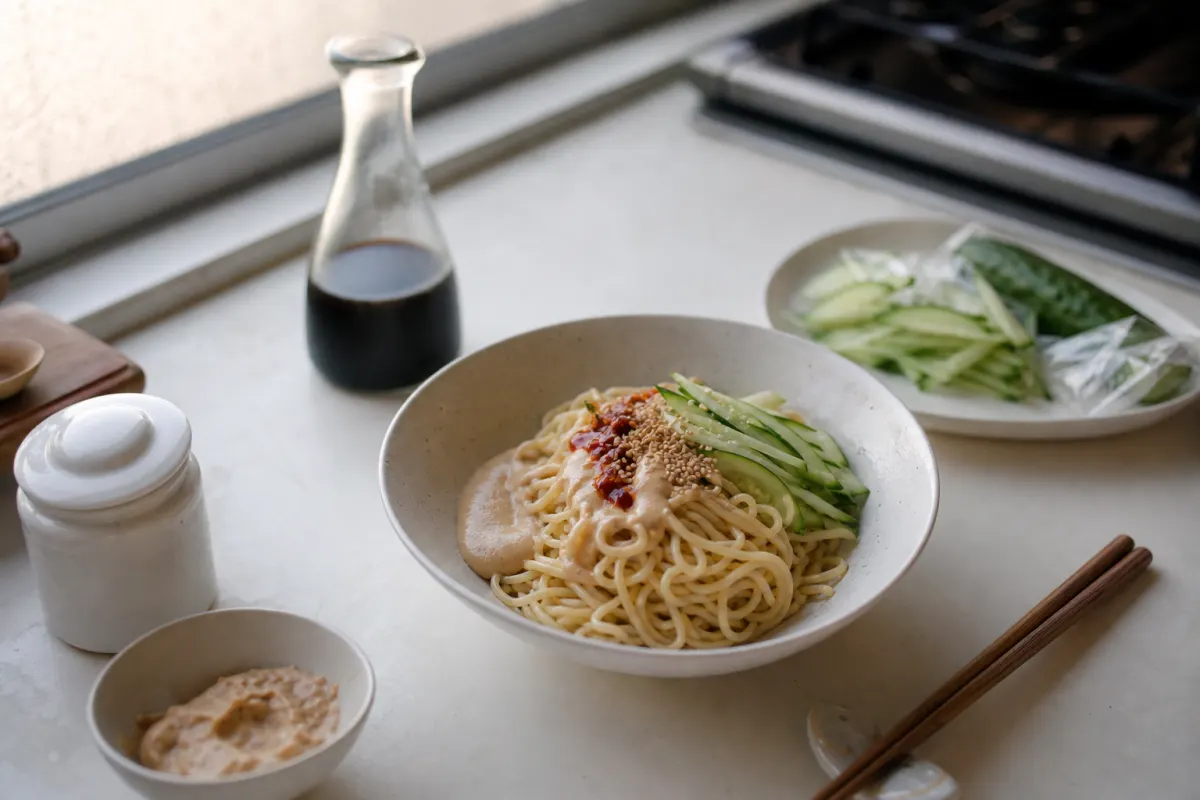
The recipe card below keeps the sauce practical for Japan: build a thick sesame-peanut paste, loosen it slowly, then spoon it over cold rinsed noodles and cucumber.
Ingredients
Method
- Cook the noodles, rinse them immediately under cold water to wash away surface starch, drain well, and toss with a tiny amount of sesame oil if they seem sticky.
- In a bowl, mix the nerigoma and peanut butter until smooth before adding the liquids.
- Add soy sauce, black vinegar, sugar, grated garlic and sesame oil. Stir into a thick paste.
- Add cold water little by little, stirring until the sauce emulsifies each time. Stop when it flows but still coats the noodles.
- Place the cold noodles in bowls, add cucumber, spoon over the sesame sauce, and finish with chili oil if you like a little heat.
Notes
- For a breakfast-shop style sauce, add a little more garlic and black vinegar.
- For a convenience-store style sauce, increase the peanut butter and sugar slightly, and keep the garlic softer.
- Always make a thick paste first, then dilute with cold water. This keeps the sauce from separating.
- If using KALDI Skippy Chunk peanut butter, start with less sugar because the peanut butter may already taste slightly sweet.
FAQ
Related reading: Cold noodles depend a lot on cucumber texture. You may also want the guide to choosing and preparing Japanese cucumbers, or a simple Taiwanese cucumber salad for the side.
Related reading: If you are adjusting sweetness between Taiwanese and Japanese ingredients, see the Japan and Taiwan sugar comparison guide.
White nerigoma or plain nerigoma is the easiest substitute. If you can find YOUKI sesame paste, that is also close. To make the sauce feel more like Taiwanese cold noodles, add a little unsweetened peanut butter for body and aroma.
Mix nerigoma and peanut butter into a paste first, then add soy sauce, black vinegar, sugar, garlic and sesame oil. Add cold water gradually until the sauce flows but still coats the noodles.
Fresh Chinese noodles or hiyashi chuka noodles are the closest easy options. Yakisoba noodles can work in a pinch if you loosen them with hot water, rinse, chill and drain them well.
Increase the peanut butter and sugar slightly, and reduce the raw garlic. Convenience-store style sesame sauce is usually smoother, sweeter and less sharp than a breakfast-shop version.
Japanese gomadare is often sweeter, thinner and more dressing-like. Taiwanese cold noodle sauce needs stronger sesame body, garlic, soy sauce and vinegar. If you start with gomadare, reinforce it with nerigoma, garlic, soy sauce and black vinegar.
Use 2 tablespoons nerigoma, 1 tablespoon peanut butter, 1.5 tablespoons soy sauce, 1 tablespoon black vinegar, 1 teaspoon sugar, 1 teaspoon garlic and 3 to 5 tablespoons cold water. Adjust garlic, sugar and vinegar depending on the style you like.
Rinse the cooked noodles under cold water, remove surface starch, drain them well, and keep the sauce emulsified by adding cold water gradually. This keeps the noodles refreshing instead of sticky.
If you remember only one rule, do not use Japanese gomadare as the finished sauce. Treat nerigoma as the sesame base, peanut butter as the Taiwanese-style body, and black vinegar as the acidity. That is the balance that makes a Japan-made bowl of cold noodles taste familiar.