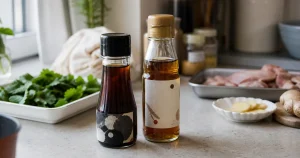
The ingredient that stops me most often in a Japanese supermarket is not always meat or vegetables. It is a small bottle of vinegar. A Taiwanese recipe says “1 tablespoon white vinegar,” but the shelf in front of you has 穀物酢, 米酢, 純米酢, すし酢, and several kinds of 調味酢. They all look pale and simple. Once they go into the dish, the difference is obvious.
If you only want to buy the safest first bottle for Taiwanese home cooking, choose 穀物酢, Japanese grain vinegar. Its acidity is clear, the aroma is light, and it fits the role that Taiwanese white vinegar usually plays in cold salads, sweet-and-sour sauces, and quick pickles. Add 米酢 later when you want a softer, rounder acidity for vinegar rice or Japanese-style side dishes. Use すし酢 and other seasoned vinegars only after reducing the sugar and salt in the original recipe.
Start here: buy 穀物酢 first for Taiwanese home cooking
In many Taiwanese dishes, vinegar is not there to make the whole plate taste strongly sour. It clears the flavor. It keeps cucumber salad crisp, makes sweet-and-sour sauce brighter, and cuts through heaviness in quick pickles or meat dishes. When you live in Japan, do not chase a bottle with the exact same name first. Ask what kind of acidity the dish needs.
| Taiwanese recipe says | Buy first in Japan | How close is it? | Best for |
|---|---|---|---|
| White vinegar | 穀物酢 | Closest everyday substitute for Taiwanese white vinegar | Taiwanese cucumber salad, sweet-and-sour sauce, quick pickles, small amounts for meat odor control |
| Rice vinegar | 米酢 | Close, but usually rounder and more rice-scented | Sushi rice, 酢の物, gentle cold vegetables, pickled onion |
| Glutinous rice vinegar or mild white vinegar | 米酢 or 純米酢 | Softer acidity | Cold dishes, rice dishes, mild pickles |
| General clean acidity | 穀物酢 | Easy to buy and neutral | Most Taiwanese home dishes |
| Sweetened vinegar sauce | A small amount of すし酢, with recipe adjustment | Already contains sugar and salt | Reduce the original sugar and salt first |
If your kitchen only has room for one bottle, and you mostly cook Taiwanese food, start with 穀物酢. It is inexpensive, easy to find, pale in color, and less likely to change the personality of a Taiwanese recipe. If you often make sushi rice, 酢の物, or softer Japanese-style cold dishes, then keeping a second bottle of 米酢 is useful.
When a Taiwanese recipe says white vinegar, look for 穀物酢
In Taiwanese recipes, white vinegar often means clean acidity. A cucumber salad needs a crisp finish. Sweet-and-sour pork needs the sourness to lift the sugar and soy sauce. A small splash in meat preparation is there to tidy the flavor, not to perfume the whole dish.
穀物酢 fits this job well. It is usually made from grains such as wheat, rice, corn, or sake lees. The flavor is light and direct, so it does not cover garlic, chili, soy sauce, or sugar. For Taiwanese cold dishes, simple pickles, and sweet-and-sour sauces, it is the easiest replacement to control.
For a first substitution, use a simple 1:1 ratio:
- Taiwanese white vinegar 1 tablespoon = Japanese
穀物酢1 tablespoon
Taste after mixing. If the acidity feels sharp, add a little sugar or let the dressing sit for a few minutes. For sweet-and-sour sauce, I like to hold back a small part of the vinegar and add it near the end so the sour aroma stays clear.
Use 米酢 when you want a softer acidity
米酢 is softer than grain vinegar and carries a gentle rice aroma. It can replace white vinegar, but the dish will feel rounder and slightly more Japanese in mood.
I choose 米酢 when I am making sushi rice, onigiri rice seasoning, 酢の物, pickled onion, pickled napa cabbage, or a cold side dish for someone who dislikes sharp acidity. It also works well when the sauce does not contain much garlic, chili, or soy sauce and needs the vinegar itself to taste smooth.
For Taiwanese cucumber salad, both 穀物酢 and 米酢 work. 穀物酢 gives a clearer lunchbox-style sweet-sour finish. 米酢 makes the salad softer, and it is pleasant if you plan to pack it for the next day. When I want a familiar Taiwanese bite, I start with 穀物酢. When I want the dish gentler, I use 米酢.
Use すし酢 or 調味酢 only after reducing sugar and salt
Japanese supermarkets also sell すし酢, 調味酢, and 便利酢. These are already seasoned. They are convenient for sushi rice, quick pickles, and nanbanzuke-style dishes, but they should not be poured into a Taiwanese recipe as if they were plain white vinegar.
For example, if the original recipe says:
- white vinegar 1 tablespoon + sugar 1 teaspoon + a pinch of salt
and you only have すし酢, some of that sugar and salt is already inside the vinegar. Start by cutting the recipe sugar and salt in half, use a little less soy sauce if needed, and then taste before adding more. This can rescue a quick cucumber or onion salad. For dishes where the sweet-and-sour ratio matters, such as sweet-and-sour pork or fish, plain 穀物酢 is much easier to control.
Taiwanese cooking substitution table
Choosing by cooking situation is usually more reliable than choosing by bottle name alone. Use this table as a small supermarket note.
| Taiwanese cooking situation | Use in Japan | Why | Adjustment |
|---|---|---|---|
| Taiwanese cucumber salad | 穀物酢; use 米酢 for a softer version | Grain vinegar is crisp; rice vinegar is rounder | With 穀物酢, add a little more sugar if sharp. With 米酢, use slightly less sugar. |
| Sweet-and-sour pork or fish | 穀物酢 | Direct acidity balances sugar and soy sauce well | Add vinegar in two stages; finish with a small splash. |
| Taiwanese cold noodle sauce | 穀物酢 or 米酢 | Grain vinegar is refreshing; rice vinegar is milder | Black vinegar has a separate aroma and is not a full white-vinegar replacement. |
| Pickled daikon or onion | 米酢 or 穀物酢 | Rice vinegar is soft; grain vinegar keeps a crisp edge | For bento side dishes, 米酢 is often gentler. |
| A small amount for meat odor or heaviness | 穀物酢 | Low aroma, so it will not turn the whole pot into a vinegar dish | Start with 1 teaspoon, not a large pour. |
| Sushi rice or 酢の物 | 米酢 | Rice aroma fits rice and Japanese cold dishes | Do not force 穀物酢 here unless it is all you have. |
| Quick pickles when you have no sugar or salt | 調味酢 can work | Already seasoned and convenient | Reduce the original sugar and salt. |
How to read vinegar labels in a Japanese supermarket
Look at the front label first, then check the ingredients and allergen information on the back. When you are new to Japanese seasonings, do not treat every clear vinegar as the same bottle.
- 穀物酢: the best everyday substitute for Taiwanese white vinegar. Clean, affordable, and useful in many dishes.
- 米酢: rice vinegar. Rounder and more rice-scented, good for rice dishes, cold vegetables, and Japanese-style sides.
- 純米酢: pure rice vinegar. Made only from rice, usually fuller and more aromatic, often more expensive.
- すし酢: sushi vinegar. Usually already contains sugar and salt.
- 調味酢 / 便利酢: seasoned vinegar. Convenient, but not a direct plain-vinegar substitute.
- りんご酢: apple vinegar. Fruity and better for salad dressings or drinks than for most Taiwanese white-vinegar uses.
Some grain vinegars contain wheat-derived ingredients. If someone in your home has a wheat allergy, read the allergen label carefully instead of judging only from the word “vinegar.”
FAQ
For most Taiwanese home cooking, start with Japanese grain vinegar, labeled 穀物酢. It has a clean, direct acidity and a light aroma, so it works well in cold salads, sweet-and-sour sauces, quick pickles, and small amounts for removing heaviness from meat dishes.
No. They are not identical products, and the grain base can differ. But in everyday cooking they fill a very similar role: pale color, clear acidity, low aroma, and wide use in sauces, pickles, and cold dishes.
Yes, but the finished dish will taste softer and slightly rounder. 米酢 is good for gentle pickles, vinegar rice, 酢の物, and cold vegetables. If you want the sharper Taiwanese lunchbox or noodle-shop style acidity, 穀物酢 is usually closer.
You can use it in an emergency, but adjust the recipe. すし酢 usually already contains sugar and salt, so reduce the sugar, salt, and sometimes soy sauce in the original Taiwanese recipe before adding more seasoning.
米酢 is rice vinegar and may have a broader, lighter rice-vinegar profile. 純米酢 is made only from rice and usually has a stronger rice aroma and fuller ingredient flavor. For everyday Taiwanese white-vinegar substitutions, you do not need to buy 純米酢 unless you specifically want that round rice aroma.
If you mostly cook Taiwanese home dishes, buy 穀物酢 first. If you often make sushi rice, 酢の物, or Japanese-style cold side dishes, buy 米酢. If you cook both styles often, keeping one bottle of each is the easiest setup.
For a Taiwanese kitchen in Japan, the practical answer is simple: keep 穀物酢 for clean Taiwanese-style acidity, add 米酢 when you want a softer rice-vinegar flavor, and treat すし酢 or 調味酢 as already-seasoned shortcuts. Once you know which bottle is plain and which bottle is seasoned, the shelf becomes much less confusing.