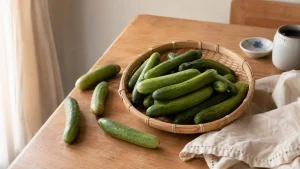
Okinawan bitter melon, often sold as goya or ゴーヤー in Japan, can taste sharper than the paler bitter melons many Taiwanese cooks are used to. The goal is not to make it completely sweet. The goal is to remove the harsh, tongue-pricking bitterness while keeping the crisp texture and the clean bitter finish that makes goya good in stir-fries, salads and Okinawan-style dishes.
For everyday cooking, the most reliable method is simple: scrape out the seeds, white pith and inner membrane well, slice the melon thinly, salt it with 4–5% of its weight for 10–15 minutes, then rinse and squeeze or drain. If it still tastes too strong, blanch it briefly and chill it in ice water.
Why Okinawan goya tastes more bitter
Bitterness varies by bitter melon variety. In general, paler white bitter melon is milder, pale-green varieties sit in the middle, and deeper green or more wild-type bitter melons taste stronger. Okinawan goya belongs to the stronger side, so if you cut it and cook it directly, the bitterness can feel rough and lingering.
Two details matter most in a home kitchen: remove the inner white pith thoroughly, and give the salted slices enough time to release water. If either step is rushed, the bitterness stays more aggressive.
Step 1: remove the seeds, pith and membrane
Wash the goya, cut it in half lengthwise, then use a spoon to scrape out the seeds, the white cottony pith and the thin inner membrane. Many people remove only the seeds, but the remaining white tissue can still make the slices taste harsh.
- Cut the goya in half lengthwise.
- Scrape out the seeds from end to end with a spoon.
- Keep scraping until the white pith and inner membrane are mostly gone.
- Stop when the inside surface looks relatively smooth.
Because Okinawan goya is naturally bitter, I scrape a little more than I would with a mild white bitter melon. This is the base step that makes salting and blanching work better.
Step 2: slice it thinly
Slice the cleaned goya into 2–3 mm slices. Thin slices let salt move in and bitter liquid move out more easily. If you are cooking for someone who dislikes bitterness, aim closer to 2 mm. If you want more crunch and bitter aftertaste, 3 mm is fine.
| Goal | Suggested thickness |
|---|---|
| Reduce bitterness clearly | About 2 mm |
| Keep more crunch and bitter finish | About 3 mm |
| Not recommended | Very thick slices; they are harder to season and de-bitter |
Step 3: salt with 4–5% for 10–15 minutes
Salting is the most important step. Use salt equal to 4–5% of the sliced goya weight. For 300 g of bitter melon, use 12–15 g salt and let it sit for 10–15 minutes. Without a scale, one medium goya usually needs about 2 teaspoons of salt, but weighing is more consistent.
How to salt bitter melon correctly
- Put the sliced goya in a bowl.
- Add salt equal to 4–5% of the goya weight.
- Massage gently so the salt touches every slice.
- Let it rest for 10–15 minutes until liquid comes out.
- Rinse quickly under clean water to remove excess salt and bitter liquid.
- Squeeze gently by hand or drain well in a sieve.
The salt draws out water, and some bitterness leaves with that liquid. A study in the Jordan Journal of Biological Sciences found that 5% salt for 15 minutes effectively reduced bitter melon bitterness and brought the sensory result close to a lightly bitter level. That condition translates well to home cooking.
For sensitive eaters: blanch and ice-chill
If the goya is still very bitter, or if you are cooking for someone who is not used to bitter melon, add a short blanch after salting.
- Scrape, slice and salt the goya for 10–15 minutes.
- Rinse, then squeeze or drain.
- Bring a pot of water to a boil.
- Blanch the slices for 30–90 seconds.
- Move them immediately into ice water.
- Chill for 3–5 minutes, then drain well.
| Bitterness tolerance | Blanching time |
|---|---|
| You want to keep the bitter finish | 30 seconds |
| You want a clear bitterness reduction | 60 seconds |
| You are very sensitive to bitterness | 90 seconds |
| Not recommended | More than 2 minutes |
Blanching reduces bitterness further, but too much heat makes goya soft and dull. Ice water stops the cooking quickly, keeps the texture crisp and helps the green color stay brighter.
Three levels of bitterness control
Light version: keep the bitter finish
- Remove the pith and membrane.
- Slice about 3 mm thick.
- Salt with 4% for 10 minutes.
- Rinse.
- Squeeze or drain.
Use this if you like the character of Okinawan goya. The bitterness remains, but it feels cleaner and less harsh.
Standard version: balanced bitterness reduction
- Remove the pith and membrane.
- Slice 2–3 mm thick.
- Salt with 5% for 15 minutes.
- Rinse.
- Squeeze or drain.
This is the most balanced method for home cooking. It reduces bitterness clearly without needing an extra blanch.
Strong version: for people who dislike bitterness
- Remove the pith and membrane.
- Slice about 2 mm thick.
- Salt with 5% for 15 minutes.
- Rinse and squeeze.
- Blanch for 60–90 seconds.
- Ice-chill for 3–5 minutes.
- Drain well.
This version lowers bitterness a lot, but it also softens the natural aroma and bitter aftertaste of goya. Use it when the eater is more important than the ingredient’s full character.
Methods I would avoid
- Long soaking in plain water: it does not remove bitterness very efficiently, and the slices can become watery.
- Long blanching: it works, but after more than about 2 minutes the slices lose crunch and fragrance.
- Too much baking soda: it may keep the color green, but it can leave an alkaline taste and strange texture.
- Trying to make goya completely non-bitter: the bitter finish is part of the vegetable. Reduce the harsh edge, not the whole personality.
FAQ
Related reading: Once the goya is prepared, you can use it in salted egg bitter melon or a simple bitter melon soup.
You can reduce the sharp bitterness a lot, but you do not need to erase it completely. Okinawan goya tastes best when the harsh edge is softened while a clean bitter finish and crunch remain.
Yes. After salting, the slices hold salty bitter liquid on the surface. Rinse quickly, then squeeze or drain well so the final dish is easier to season.
Salting is enough if you enjoy a little bitter aftertaste. Blanching is an extra step for very bitter goya or for people who are sensitive to bitterness.
Ice water stops residual heat from softening the slices. It keeps the color cleaner and the texture more crisp, especially when the goya will be used in salad or quick stir-fry.
Use 4–5% of the bitter melon weight. For 300 g of sliced goya, that is about 12–15 g salt. If you do not have a scale, use about 2 teaspoons for one medium bitter melon and adjust next time.
Summary
Okinawan goya tastes stronger than many common bitter melons, so do not try to treat it as a mild vegetable. Scrape out the seeds, white pith and inner membrane, slice it thinly, then salt it with 4–5% of its weight for 10–15 minutes. Rinse and drain well. If the bitterness is still too strong, blanch briefly and ice-chill. The result is less sharp, still crisp, and still recognizably goya.
References
- Ummi Rohajatien et al., “Optimization of the Process of Reducing the Bitterness of Bitter Melon with Response Surface Methodology,” Jordan Journal of Biological Sciences, Vol. 16, No. 1, 2023, pp. 85–92.
- N. P. Minh, “Feasibility of Bitterness Reduction in Bitter Gourd (Momordica charantia) Dried Powder by Blanching, Enzyme, and Wall Material,” Journal of Global Pharma Technology.
- Liberty Times Food article on reducing bitterness in bitter melon, including pith removal, salting, blanching and ice-chilling.
- Taiwan agricultural extension material comparing bitter melon varieties and noting that wild-type mountain bitter melon tends to taste more bitter.