When I miss Taiwanese dougan in Japan, I do not start from soybeans or soy milk. I start with one block of momen tofu from the supermarket, press out the water slowly, give it a light soy sauce and five-spice color, and dry the surface until the pieces feel firm enough to slice, pan-fry, or pack into a lunch box.
This is a home version, not factory-made dougan. The pieces will not be perfectly uniform, and they will not have the same compressed bite as commercial tofu curd. But if you press the tofu well and dry the surface properly, the texture becomes much closer to Taiwanese dougan than ordinary soy-sauce tofu.
The whole method depends on three things: press water out in stages, color lightly with soy sauce and five-spice powder, then dry the surface at the end. Once you understand those three steps, you can make it with a toaster oven, a microwave, or a microwave followed by a quick pan-fry.
The key to dougan is removing water
Dougan feels chewy because much of the water has been removed. At home, think of the process like this: press the tofu first, color the surface, then dry it in a toaster oven or microwave.
If you skip the pressing step and only brush tofu with soy sauce, the center stays wet and soft. It will taste like seasoned tofu, not dougan. Pressing makes the tofu thinner and tighter, so the later drying step can actually change the texture.
Why momen tofu works
In Japanese supermarkets, you will usually see 絹ごし豆腐 and 木綿豆腐. For this method, choose 木綿豆腐 / momen tofu.
Momen tofu is firmer and holds less water than silken tofu. It can sit under weight without falling apart too easily. Silken tofu is lovely for hiyayakko or miso soup, but it is too tender for long pressing and tends to break before it becomes firm.
Ingredients
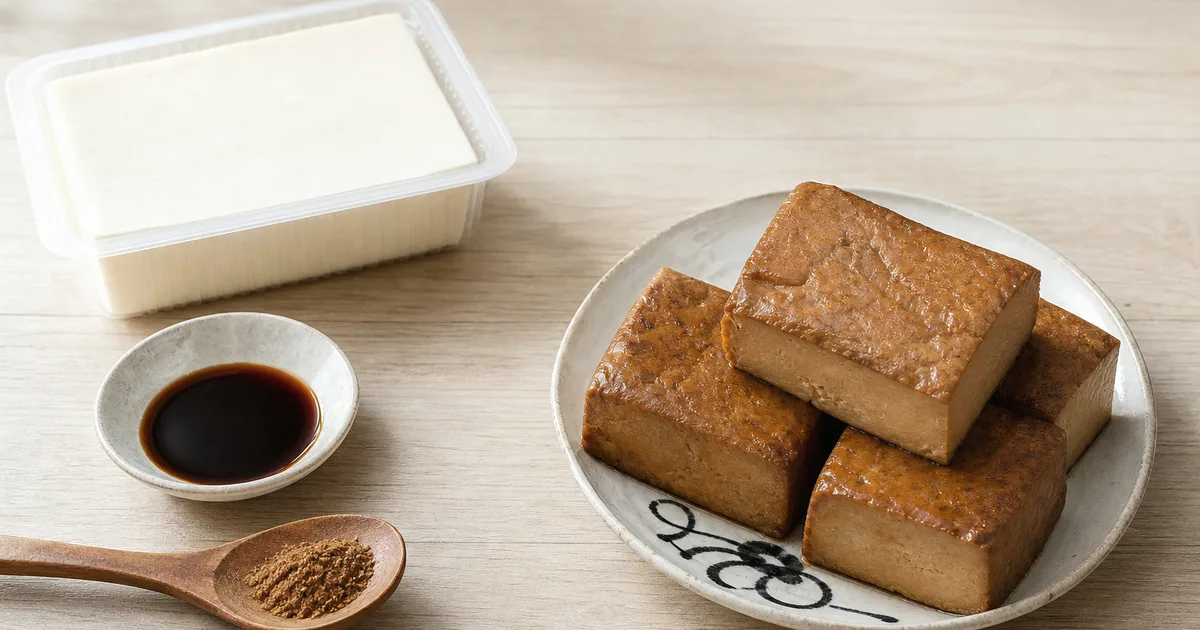
- 1 block momen tofu / 木綿豆腐, about 300–400 g
- 2–3 tablespoons regular soy sauce
- 1/4 teaspoon five-spice powder
One block usually becomes about 6 small pieces of homemade dougan after pressing, cutting, and drying. The soy sauce is mainly for color and aroma; it is not meant to turn the tofu into a very salty braised snack. Use only a small amount of five-spice powder, because too much can taste powdery or bitter.
Do not use dashi soy sauce
For a Taiwanese-style flavor, use regular dark soy sauce or Japanese 濃口醤油. Avoid 昆布しょうゆ, かつお醤油, だし醤油, めんつゆ, and 白だし.
Those seasonings bring a clear Japanese dashi sweetness and kelp or bonito aroma. They are useful in many dishes, but they make this dougan taste less like Taiwanese soy-and-five-spice dougan.
How to make dougan from tofu
1. Drain the momen tofu
Take the tofu out of the package, discard the water, and pat the surface dry with kitchen paper. If the block is thick, cut it horizontally into two thinner slabs before pressing.
2. Press the tofu in three stages
Put kitchen paper or a clean cloth under and over the tofu. Place a flat plate on top, then increase the weight gradually:
- First round: light pressure for 30 minutes.
- Second round: medium weight for 1–2 hours.
- Third round: heavier weight until the total pressing time reaches about 4–6 hours.
Pour off the water and change wet paper between rounds. Do not put heavy weight on the tofu from the beginning, or it may crack.
3. Cut into 6 small pieces
The pressed tofu should look thinner and feel firmer. Cut it in half, then cut each half into 3 pieces. Smaller pieces dry more evenly; very large pieces tend to stay wet in the center.
4. Color with soy sauce and five-spice powder
Mix the soy sauce and five-spice powder, then coat the tofu pieces evenly. Let them sit for 5–10 minutes only. A long soak can make the tofu too salty and can also make it absorb moisture again.
Toaster oven version
A toaster oven gives the driest surface and a little roasted edge, so this version feels closest to dougan.
- Line the tray with baking paper and keep the tofu pieces in one layer.
- Drain off excess soy sauce before baking.
- Toast for 8–10 minutes, then flip.
- Toast for another 6–10 minutes, until the surface is no longer wet, the edges shrink slightly, and the pieces can be picked up with chopsticks without breaking easily.
If your toaster oven runs hot, shorten the time. If the tofu is thick, add a few minutes, but do not bake it until hard and dry.
Microwave version
The microwave version is faster, but you need short rounds so the outside does not harden while the center stays wet.
- Put the tofu pieces on a heatproof plate in one layer. Blot extra sauce first.
- Microwave at 500W for 1 minute, then pour off water and flip.
- Microwave again for 30 seconds to 1 minute, repeating 2–3 times.
- Each time, open the door to release steam, pour off liquid, and flip the pieces until the surface feels dry.
Let the tofu rest for 5–10 minutes after microwaving. As steam leaves the surface, the texture becomes firmer and closer to dougan.
Success tips
- Increase the weight gradually: slow pressing keeps the tofu shape more intact.
- Use soy sauce for color, not soaking: a short coating gives aroma without making the tofu too salty or wet.
- Dry the surface at the end: if the surface still looks wet, the result will taste more like soy-sauce tofu than dougan.
Toaster oven vs microwave
| Method | Texture | Watch point |
|---|---|---|
| Toaster oven | Drier surface, more roasted, closer to dougan | Adjust time to your toaster oven strength |
| Microwave | Fast, but less even | Heat in short rounds, pour off water, and flip |
| Microwave, then pan-fry | Most fragrant, like pan-fried dougan | One extra step |
If you have a toaster oven, use it first. If you only have a microwave, it still works; just avoid one long heating round.
Storage and serving
Cool the homemade dougan completely, then refrigerate it in a sealed container. Eat within 2–3 days. This home version is not vacuum-packed or sterilized, so it should not be stored for a long time.
You can eat it cold, microwave it for 20–30 seconds, pan-fry it over low heat, slice it into stir-fried vegetables, or toss it with chili oil and sesame oil.
Recipe card
Ingredients
Method
- Remove the momen tofu from the package, discard the water, and pat the surface dry. If the block is very thick, cut it horizontally into two thinner slabs.
- Place kitchen paper or a clean cloth under and over the tofu. Press lightly for 30 minutes.
- Change the wet paper, add medium weight, and press for another 1–2 hours.
- Change the paper again, add heavier weight, and press until the total pressing time is about 4–6 hours. Do not start with very heavy weight or the tofu may crack.
- Cut the pressed tofu into 6 small pieces so the center can dry evenly.
- Mix the soy sauce and five-spice powder. Coat the tofu pieces evenly and let them sit for 5–10 minutes only.
- For a toaster oven: drain off extra sauce, place the tofu on baking paper, toast for 8–10 minutes, flip, then toast another 6–10 minutes until the surface is dry and the edges shrink slightly.
- For a microwave: place the tofu on a heatproof plate, microwave at 500W for 1 minute, pour off water, flip, then repeat 30-second to 1-minute rounds 2–3 times until the surface is dry.
- Let the dougan rest for 5–10 minutes before eating so steam can leave and the texture becomes firmer.
Notes
- Use regular soy sauce or 濃口醤油. Avoid 昆布しょうゆ, かつお醤油, だし醤油, めんつゆ, and 白だし if you want a Taiwanese-style flavor.
- Soy sauce is for color and aroma, not for making a very salty braise.
- The chewy texture depends on pressing and final drying. If the surface stays wet, it will taste more like seasoned tofu.
- Refrigerate homemade dougan and eat within 2–3 days.
FAQ
Yes. For a home version, press momen tofu in stages until it becomes thinner and firmer, color it with soy sauce and five-spice powder, then dry the surface in a toaster oven or microwave. It will not be identical to factory-made dougan, but it becomes much firmer than regular tofu.
Yes. Use the same idea: press it for 4–6 hours, or longer if it is very wet, then slice it, season it, and dry the surface. If the tofu is thick, cut it thinner so the center does not stay soft.
Water removal is the key. Seasoning alone only makes soy-sauce tofu. Press the tofu first, then color it, then dry the surface so the texture becomes chewy instead of wet and soft.
No. A toaster oven gives a drier, more fragrant surface, but a microwave also works if you heat in short rounds, pour off water each time, and flip the pieces.
Use 500W in short rounds of 30 seconds to 1 minute. Open the door, let steam escape, pour off liquid, and flip the tofu each time. Do not microwave for a long time in one round, or the edges may harden while the center stays wet.
I do not recommend it. Silken tofu contains more water and breaks easily under long pressing. In Japan, choose 木綿豆腐, or another firm tofu, for this method.
No. This method starts with already-made tofu and turns it into a home-style tofu dougan. You are not making tofu from soy milk, so you do not need nigari, gypsum, or brine-setting ingredients.
Usually the tofu was not pressed or dried enough. Press for at least 4–6 hours, cut the tofu into smaller or thinner pieces, and dry the surface in short toaster-oven or microwave rounds until it no longer looks wet.
Cool it completely, store it in a sealed container, and refrigerate it. Eat within 2–3 days. This home version is not vacuum-sterilized, so it is not meant for long storage.
If you are rebuilding Taiwanese pantry ingredients in Japan, this tofu dougan is a useful small project. It does not need a special brine or a factory press. Once the water is handled well, a simple block of momen tofu can become something firm enough for bentos, stir-fries, and a quiet plate with rice.