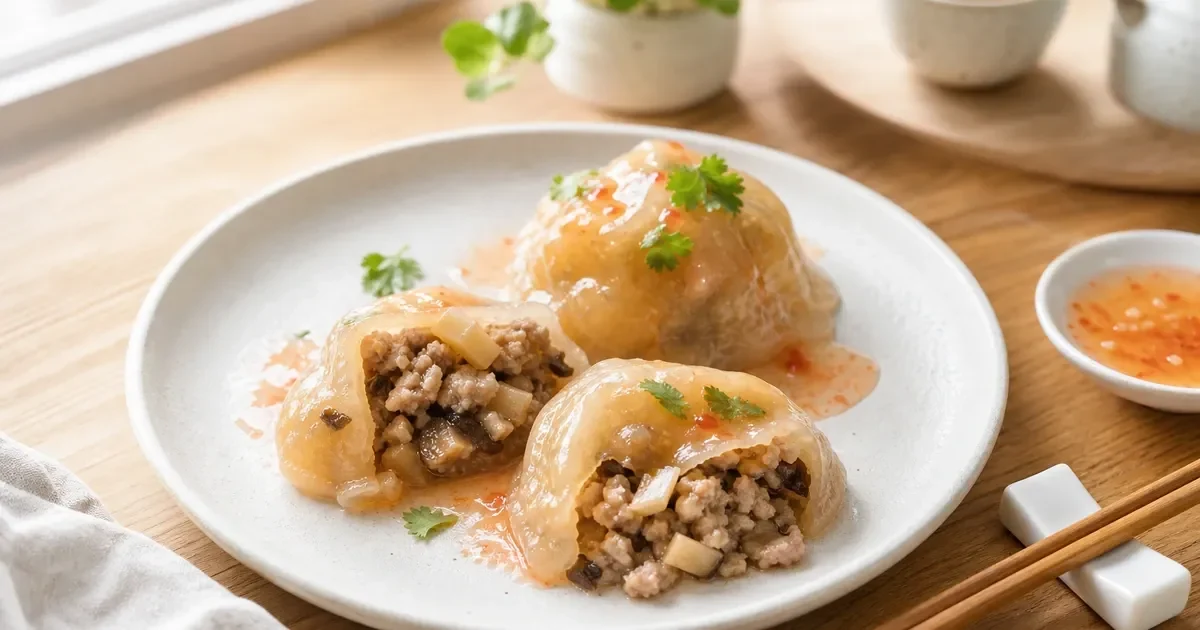
Ba Wan (肉圓) is one of Taiwan’s most beloved street food snacks — a plump, translucent dumpling with a tender pork filling, topped with a glossy sweet-savory sauce. But ask anyone who’s tried making it at home, and you’ll hear the same story: the traditional sweet potato starch skin is notoriously hard to get right. Too much water and it falls apart; too little and it turns gummy.
Here’s the fix: swap the sweet potato starch skin for Vietnamese rice paper. The result? A Ba Wan that’s crystal-clear, chewy, and Q-elastic — with almost none of the technical difficulty of the original. No tricky ratios, no deep-frying. Just steam and serve.
Rice Paper vs. Traditional Ba Wan Skin: What’s the Difference?
If you’ve never heard of rice paper Ba Wan, you might wonder whether it can really compare to the classic. Here’s an honest breakdown:
| Vietnamese Rice Paper | Traditional Sweet Potato Starch Skin | |
|---|---|---|
| Appearance | Crystal-clear after steaming | Semi-translucent, slightly hazy |
| Texture | Bouncy and chewy, with a subtle rice fragrance | Soft and silky, slightly sticky |
| Difficulty | Soak for 5–8 seconds — nearly foolproof | Requires precise starch-to-water ratios; easy to fail |
| Health | Steamed with minimal oil | Traditional version requires deep-frying |
| Prep time | No skin-making step needed | Time-consuming starch preparation |
The short version: rice paper Ba Wan is more transparent, much easier to make, and lower in oil. The texture is a little different, but equally delicious — and far more achievable for home cooks abroad.
Tips for Getting It Right
- Choose thicker rice paper: Thin sheets are more prone to tearing after soaking. Look for Vietnamese-brand round rice paper at Asian grocery stores.
- Fat matters in the filling: A 70/30 lean-to-fat ratio keeps the pork moist and flavorful. All-lean ground pork tends to dry out during steaming.
- Check for doneness: The wrapper should be completely transparent — if it still looks white or hazy in spots, give it another 2–3 minutes.
- Storage: Refrigerate leftovers for up to 2 days. Re-steam for 5 minutes to restore the chewy texture before eating.
Love Taiwanese street food made at home? Check out this Taiwanese Oyster Omelette recipe — another night market classic that’s surprisingly doable in your own kitchen.
Full Vietnamese Rice Paper Ba Wan Recipe
Ingredients
Method
- Soak dried shiitake mushrooms in warm water for 20 minutes. Squeeze out excess water and dice finely. If using fresh bamboo shoots, blanch them until fully cooked and let cool before dicing.
- Combine ground pork, diced bamboo shoots, diced mushrooms, garlic, soy sauce, white pepper, sesame oil, sugar, and rice wine in a large bowl. Stir in one direction until the mixture becomes sticky and well combined. Marinate for 15 minutes.
- Dip one sheet of rice paper into cold or slightly warm water for 5–8 seconds only, then lay it flat on a damp cloth or silicone mat. It will continue to soften — you want it pliable but still slightly firm. If it gets too wet, it’ll tear when you fold it.
- Scoop about 25 g (roughly 1 tablespoon) of filling and shape it into a small oval. Place it in the center of a rice paper sheet. Fold the bottom edge up, fold in the left and right sides, then roll tightly upward. Place seam-side down. Repeat until all the filling is used.
- Lightly oil the steamer tray. Arrange the wrapped Ba Wan seam-side down, leaving a little space between each one. Once the water is boiling, steam over medium-high heat for 15–18 minutes, until the wrappers turn completely transparent and the filling is cooked through.
- Mix together the thick soy sauce, garlic chili sauce, chili sauce, sugar, and warm water. Stir until the sugar dissolves. Adjust to taste.
- Brush a little oil over the finished Ba Wan for extra shine. Serve hot with the dipping sauce on the side.