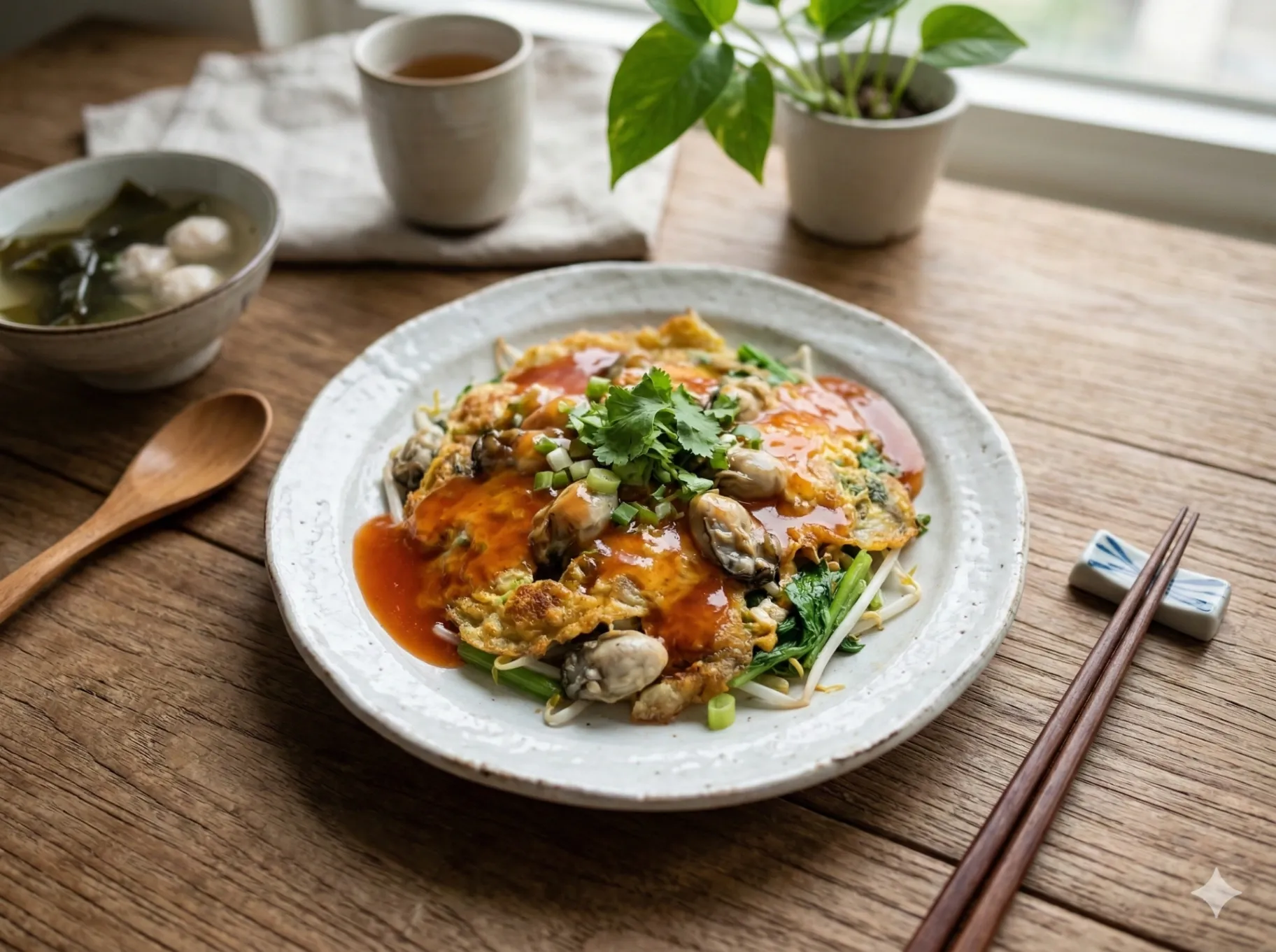
That sizzle. That smoky, savory hit of oysters hitting a blazing-hot iron griddle — if you’ve ever wandered a Taiwanese night market after dark, you know exactly what I’m talking about. The Taiwanese oyster omelette (蚵仔煎, Ô-á-chian in Taiwanese Hokkien) is the street food that stops you mid-stride every single time. Part crispy, part chewy, draped in a sweet-savory red sauce, it’s one of those dishes that’s deceptively simple to make — once you nail the batter ratio. Living in Japan? Good news: almost every ingredient is within arm’s reach. Let’s bring the night market home.
📋 In This Article
The Legend Behind the Omelette
The story most Taiwanese will tell you dates back to 1661. When the Ming loyalist general Koxinga (Zheng Chenggong) landed his troops on Taiwan to drive out the Dutch, the Dutch reportedly seized all the rice supplies to starve the incoming army. In a pinch, the locals improvised — mixing sweet potato starch with whatever they had on hand, including the briny oysters that have thrived along Taiwan’s western coastline for centuries. Whether the legend is perfectly accurate or not, it beautifully captures what this dish is: resourceful, coastal, and unmistakably Taiwanese.
Taiwan’s western coast — from Yunlin down through Chiayi and Tainan — has long been prime oyster country. Shallow tidal flats, warm currents, and generations of farming know-how make Taiwanese oysters the soul of this dish. The omelette evolved from survival food to night market icon, and today no trip to a Taiwanese night market is complete without one.
Batter Science: The Secret to That Texture
Here’s where most home cooks go wrong: they treat this like a regular egg omelette. It isn’t. The magic of Ô-á-chian lives entirely in the starch batter — a two-starch blend that creates a texture you can’t get any other way.
- Sweet potato starch (地瓜粉) — This is the hero. It fries up with crispy, slightly chewy edges and gives the omelette its signature lacy, golden skirt. If you can’t find it, tapioca starch is the closest substitute — the texture is nearly identical, just slightly smoother on the outside.
- Tapioca starch / potato starch (太白粉) — This adds the elastic, QQ (chewy-bouncy) interior that Taiwanese food lovers obsess over. Think of it as the balance to sweet potato starch’s crunch.
The golden ratio: roughly 2 parts sweet potato starch to 1 part tapioca starch, thinned with water to a consistency just slightly thicker than whole milk. Mix until smooth, then — critically — let it rest for 10–15 minutes. This resting time lets the starches fully hydrate and the batter stabilize. Skip this step and your omelette will be gummy, not lacy.
One more pro tip: cook on high heat. A medium-hot pan gives you sad, pale, soggy results. You want that batter to hit a screaming-hot surface and immediately start crisping at the edges.
Recipe
Ingredients
Equipment
Method
- Rinse oysters and gently pat dry with paper towels. Excess moisture will cause the batter to go watery and lose crispiness.
- Combine sweet potato starch, cornstarch, salt, and white pepper. Add cold water and whisk gently until just combined (do not over-mix). Rest for 10–15 minutes.
- Combine all sauce ingredients in a small saucepan. Cook over low heat, stirring constantly, until thickened. Set aside.
- Heat a cast iron or heavy-bottomed pan over high heat. Add oil. When the oil just starts to smoke, stir the batter and pour it in. Quickly spread into a thin round with a spatula.
- While the batter is still soft on top, scatter the oysters and greens across it. Press lightly with the spatula to help them sink in.
- Crack the egg alongside the batter. Once the white is half-set, flip it over the oysters with the spatula.
- Flip the whole omelette over. Cook over medium-high for 1–2 minutes until the bottom is golden and crispy. Plate and drizzle generously with sauce.
Notes
- Salt-rinse the oysters before cooking to remove grit and reduce any fishiness. Drain and dry well.
- Higher sweet potato starch ratio = chewier texture. Higher cornstarch ratio = softer result.
- Be gentle when flipping — the batter can tear if it has not set enough.
- More oil + medium-high heat = crispier edges. Do not skip the oil.
- The sauce is the soul of this dish. Homemade beats store-bought sweet chili sauce by a wide margin.
Troubleshooting FAQ
Something went sideways? Here are the four most common problems and exactly what caused them:
❓ My omelette came out soft and mushy — not crispy at all.
Two possible culprits. First, your heat was too low — the batter never had a chance to crisp up before it absorbed oil and went limp. Always preheat your pan until properly hot before adding oil, and keep the flame high throughout. Second, your batter may be too thin. If it pours like water, add a bit more sweet potato starch and rest it again.
❓ The outside is burnt but the inside is still raw and gluey.
Heat too high, or pan too dry. Once you pour the batter, don’t crank to maximum. High-medium is your sweet spot — enough to crisp the edges but allow the inside to set before the bottom scorches. Also make sure you’re using enough oil; this batter sticks hard to a dry surface.
❓ The oysters released so much water they made the whole thing soggy.
The oysters weren’t drained properly. Fresh oysters hold a shocking amount of liquid. After rinsing, pat them completely dry with paper towels and let them sit on a rack for a few minutes before cooking. Wet oysters steam instead of sear, and that steam soaks straight into your beautiful batter.
❓ The texture was dense and tough, like rubber.
Over-mixed batter. Starch batter doesn’t need or want aggressive stirring. Mix just until the lumps are gone, then stop. Overworking it develops a dense, rubbery structure that no amount of heat will fix. Gentle hands = tender omelette.
Ingredient Swaps in Japan
Living in Japan makes this recipe surprisingly accessible. Here’s your cheat sheet:
| Original Ingredient | Where to Find in Japan | Notes |
|---|---|---|
| Sweet potato starch (地瓜粉) | 業務スーパー, large Donki stores, or online (Amazon JP / Rakuten) | Look for「さつまいもでんぷん」or「甘藷でんぷん」. Gyomu Super import section often carries Taiwanese brands. Substitute: Tapioca starch (タピオカ粉) is the best swap — nearly identical texture. Use 1:1. |
| Tapioca starch / 太白粉 | Any supermarket | 片栗粉 (katakuriko / potato starch) is a perfect 1:1 substitute — same QQ result. |
| Fresh oysters (牡蠣) | Fish sections at most supermarkets, especially Nov–Mar | Japanese oysters are larger and milder. Use fewer pieces and halve large ones. Peak season aligns well with oyster omelette cravings. |
| Bok choy / 小白菜 | Asian grocery stores, Shin-Okubo, or international supermarkets | 小松菜 (komatsuna) is an excellent swap — similar texture, mild flavor, widely available year-round. |
| Taiwanese sweet chili sauce (甜辣醬) | Costco Japan, online, some Donki branches | In a pinch: mix ketchup + soy sauce + a little sugar + chili oil. Not identical, but it works. |
There’s something almost cinematic about making Ô-á-chian at home. The moment that starch batter hits a hot oiled pan and starts sizzling at the edges, the smell alone transports you — fluorescent lights overhead, a crowd pressing in, the vendor’s spatula moving with years of practiced ease. You can’t fully replicate the drama of a night market in a Tokyo apartment kitchen. But you can absolutely replicate the flavor. Make this on a rainy Friday night. Pour a cold beer. Close your eyes at the first bite. You’ll get there.