Every year around Qingming (Tomb Sweeping Day), the air seems to fill with the sweet fragrance of peanut powder. Lines of people at the market buying spring roll wrappers, kitchens with ingredients spread across the entire table—this is a shared annual memory for many Taiwanese families.润饼 (run bing) is more than just a snack; it’s a ritual—the whole family gathers around the table, each person picks their favorites, and layers the flavors of spring into thin, delicate wrappers, one by one. This article takes you from the thousand-year history of run bing, then guides you step by step to make authentic Taiwanese spring rolls at home.
—
The History of Run Bing: From the Cold Food Festival to the Qingming Table
The story of run bing begins with a great fire over two thousand years ago.
During the Spring and Autumn period, Duke Wen of Jin (Chong’er) spent nineteen years in exile. His loyal minister Jie Zhitui once cut flesh from his own thigh to feed his starving lord, yet after Chong’er ascended the throne, Jie chose to live as a hermit on Mount Mian. To force him out, Chong’er set the mountain ablaze, but Jie refused to leave—he and his mother perished in the flames. Overwhelmed with remorse, Chong’er decreed that no fires be lit around the anniversary of Jie’s death. The people could only eat cold food, and this became the origin of the “Cold Food Festival” (寒食節)—for three full days starting on the 105th day after the winter solstice, no cooking fires were allowed.
Without fire, people wrapped pre-cooked vegetables and meats in thin wheat pancakes to eat—this was the earliest prototype of the spring roll. By the Tang Dynasty, the fire ban during the Cold Food Festival had gradually relaxed, and since the Cold Food Festival fell only a day or two before Qingming, the two festivals merged over time. The custom of eating spring rolls naturally carried forward with Qingming.
During the Ming and Qing Dynasties, waves of Hokkien immigrants crossed the Taiwan Strait, bringing this traditional Qingming food to Taiwanese tables. As for the name “run bing” (潤餅)—one theory suggests that the Hokkien pronunciation of “year” (年) sounds close to “lun” (輪), which shifted to “run” (潤). Others believe the character “run” (meaning moist, abundant) symbolizes the idea of generously wrapping all good things inside the pancake. Either way, the name carries a wish for a bountiful life.
Interestingly, run bing goes by different names across Taiwan. People in the north mostly call it “run bing” (潤餅), while southerners prefer “chun juan” (春捲, spring roll). In Tainan, spring rolls include a distinctive dry-fried egg crumble, and in Chiayi, some shops even add eel. Regional flavors differ, but the spirit of Qingming family reunion remains the same.
—
What’s the Difference Between Run Bing and Spring Rolls?
Many people can’t tell run bing from spring rolls. In fact, “spring roll” (春捲) is a broad umbrella term for any food wrapped in thin wheat skin, while “run bing” is a specific member of the spring roll family. The key difference: run bing is not fried; spring rolls (fried spring rolls) are deep-fried.
Here’s a more detailed comparison:
– Run bing (Taiwanese-style): All fillings are fully cooked. You wrap and eat immediately—no frying. The emphasis is on the softness of the wrapper, the crunch of the vegetables, and the sweet fragrance of the peanut sugar powder. It’s served at room temperature, perfect for the mild warmth of the Qingming season.
– Fried spring rolls: Typically filled with raw or semi-cooked ingredients, then deep-fried until golden and crispy. The exterior is crunchy, the interior piping hot. Commonly found at banquets or street food stalls.
In terms of occasion, run bing leans toward a communal family meal—ingredients are spread across the table, everyone wraps their own, chatting as they go, in a relaxed atmosphere. Fried spring rolls are usually pre-made and served, a more formal dish.
The easy way to remember: run bing is “wrap and eat,” fried spring rolls are “fry and eat.”
Taiwanese Spring Rolls Recipe
Ingredients
Method
- Cut pork belly into chunks and blanch in cold water to remove impurities; drain. In a fresh pot, add soy sauce, rock sugar, rice wine, star anise, and enough water to cover the meat. Bring to a boil over high heat, then reduce to low heat, cover, and braise for about 50 minutes until chopsticks can pierce through easily. Let cool, then slice or shred.
- Cut pressed tofu into strips. Heat a pan with a little oil and pan-fry over medium heat until lightly golden on both sides.
- Beat eggs with a pinch of salt. Lightly oil a flat pan, cook thin egg crepes over low heat, let cool, and cut into strips.
- Heat a dry pan (no oil), add cabbage and bean sprouts with 2 tbsp water, cover and steam for 5 minutes. Season with salt, then spread out on a plate to drain and cool completely (critical step).
- Mix peanut powder and raw cane sugar evenly; set aside.
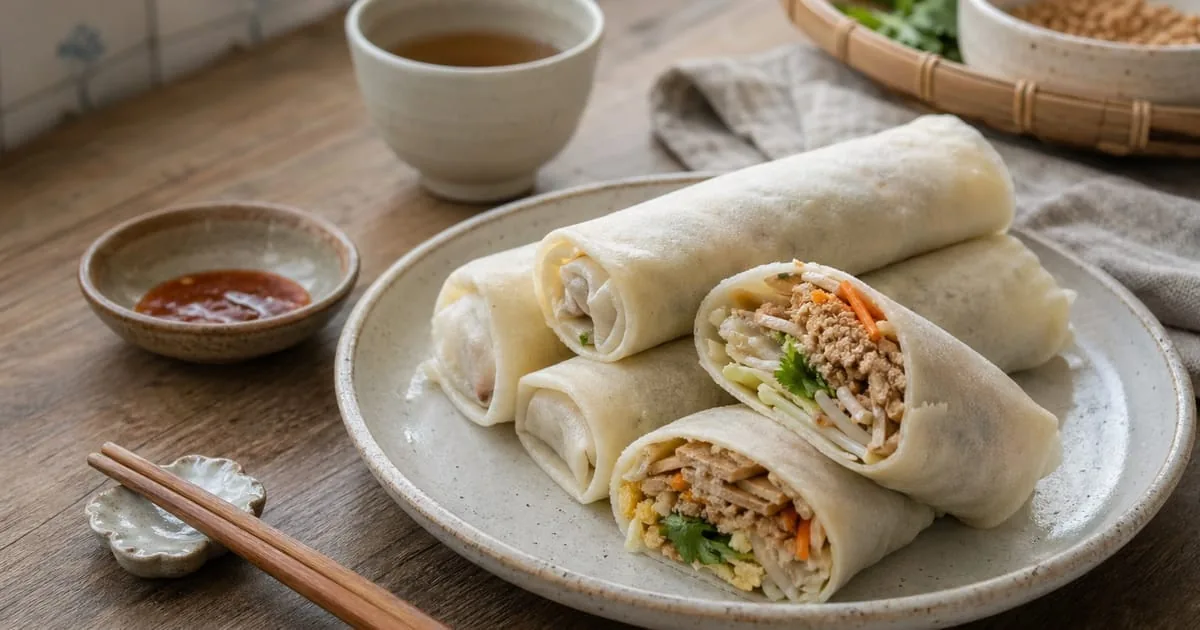
- Stack 2 spring roll wrappers. Sprinkle peanut sugar powder as a base layer, then arrange fillings in order: cabbage & bean sprouts → egg crepe → pressed tofu → red-braised pork → cilantro. Place fillings in the lower third of the wrapper.
- Fold the bottom edge up over the fillings, fold both sides inward, then roll tightly from bottom to top. Cut diagonally and serve.
Calorie Count for Taiwanese Spring Rolls
One Taiwanese spring roll (using this recipe’s fillings) contains approximately 380–430 kcal. Here’s an estimated breakdown by ingredient:
| Ingredient | Amount (per roll) | Approx. Calories |
|---|---|---|
| Spring roll wrappers (2 sheets) | ~50g | ~80 kcal |
| Cabbage + bean sprouts | ~80g | ~25 kcal |
| Egg crepe | ~30g | ~45 kcal |
| Pressed tofu | ~30g | ~50 kcal |
| Red-braised pork belly | ~50g | ~160 kcal |
| Peanut sugar powder | ~1 tbsp | ~60 kcal |
Note: Calorie count varies depending on the fat ratio of the pork belly and the amount of peanut powder used. To reduce calories, substitute the red-braised pork with chicken breast or tofu—this can bring each roll down to around 300 kcal.
Key Tips for Wrapping Run Bing
– Drain your vegetables thoroughly: This is the most important step. Excess moisture from vegetables is the number one cause of torn wrappers. After stir-frying, spread the vegetables out to cool and squeeze out any extra liquid—this also keeps the texture crisp and refreshing.
– Use two wrappers stacked together: A single spring roll wrapper is paper-thin. When wrapping juicy meats or generous fillings, it tears easily. Doubling up not only makes it sturdier but also adds a pleasant chewy texture.
– Lay down peanut sugar powder first: This isn’t just for flavor—it’s functional. The powdery peanut sugar absorbs moisture from the fillings, keeping the wrapper dry and preventing it from going soggy.
– Don’t overfill: Greed is the enemy of run bing. Place fillings only in the lower third, and leave at least 2 cm on each side for folding. This gives you enough room to tuck and roll neatly—no blowouts.
—
FAQ
Q1: How do I choose spring roll wrappers?
You can find ready-made spring roll wrappers at markets or supermarkets. When choosing, look for these things: the color shouldn’t be too stark white (overly white wrappers may contain bleaching agents)—natural wrappers will have a slight off-white, creamy tone. They should feel elastic to the touch but not overly chewy—wrappers that are too chewy won’t conform to the fillings, while ones that are too stiff will crack when folded. After buying, cover them with a damp cloth or plastic wrap to prevent drying. When ready to use, peel them apart one by one gently to avoid tearing.
Q2: What can I use instead of red-braised pork?
Red-braised pork is the classic Taiwanese run bing filling, but if you’re short on time or want a change, there are several alternatives: braised ground pork (lu rou, a convenience store or freezer staple), char siu slices, popcorn chicken pieces diced up, or simply pan-fried pork belly slices with a drizzle of soy paste. For vegetarians, try vegetarian pork floss or pan-fried shiitake mushroom slices—they offer a similarly savory, layered flavor.
Q3: How should I store leftover run bing?
It’s not recommended to refrigerate fully assembled rolls—the wrappers absorb moisture and turn soggy. The correct approach: store each filling separately in bowls, cover with plastic wrap, and refrigerate. When ready to eat, take out the portions you need and microwave for 1–2 minutes, then wrap and eat fresh for the best texture. Store wrappers separately, wrapped in plastic wrap at room temperature (same day) or refrigerated (use within the next day). Red-braised pork and pressed tofu keep for 3 days refrigerated; vegetables should be consumed within 1–2 days.
Q4: Can I skip the peanut powder?
You can, but it’s strongly not recommended. Peanut sugar powder is the most distinctive flavor of Taiwanese run bing—without it, it’s like lu rou fan without the braised pork. Technically still a bowl of rice, but the soul is gone. If you have a peanut allergy, try substituting with toasted sesame powder mixed with sugar—the aroma is different but provides the same warm, nutty richness. If you’re simply worried about sweetness, reduce the sugar ratio, but keep the peanut powder itself.
Q5: Can I make the wrappers from scratch?
Yes, but the difficulty level is high. Traditional spring roll wrappers are made by “smearing” a ball of high-gluten dough onto a hot iron griddle—you need to repeatedly swing and slap the dough to develop the gluten’s elasticity, then quickly rotate it on the griddle to form a thin skin. This technique requires extensive practice; beginners often end up with wrappers that are too thick or full of holes. If you’d like to try, search for “spring roll wrapper tutorial” videos online and start practicing with small wrappers. For most people, though, buying ready-made wrappers is the most practical choice.
—
A thin wrapper that holds the weight of history, the warmth of family, and the sweetness of peanut powder that inevitably scatters across the table. This Qingming, put aside the takeout menus and wrap a roll of your own run bing with your family.
—