If you grew up eating Taiwanese home cooking, the smell of bitter melon simmering with pork ribs probably takes you straight back to your grandmother’s kitchen on a sweltering summer afternoon. This soup — humble, slightly bitter, deeply savory — is one of Taiwan’s most beloved warm-weather dishes. And yes, you can absolutely make it in Japan. This guide walks you through everything: where to find bitter melon, how to tame its bitterness, and the little tricks that make Japanese pork ribs taste just right.
📋 In This Article
Where to Buy Bitter Melon in Japan
The good news: bitter melon (gōyā / ゴーヤ) is widely available in Japan, especially during summer. Here’s where to look:
- Regular supermarkets (June–September): Most Japanese supermarkets stock gōyā during summer. Look in the vegetable section near other seasonal produce. Okinawan-style bitter melon is the most common variety and works perfectly for this soup.
- Asian grocery stores year-round: Shops like Gyomu Super (業務スーパー), Kaldi, or dedicated Chinese/Southeast Asian grocery stores often carry bitter melon outside of peak season.
- Frozen bitter melon: Gyomu Super usually stocks frozen sliced gōyā — a convenient option that skips the prep work and is available all year.
- Can’t find any? Use daikon instead: White radish (daikon / 大根) makes a surprisingly good substitute. It has a mild sweetness that balances the richness of the pork broth beautifully, though the flavor profile will be different — more gentle, less medicinal.
How to Reduce the Bitterness: 3 Simple Steps
Bitter melon’s intensity can surprise first-timers — or frustrate even seasoned cooks. These three steps will dial it back to a pleasant, approachable level without killing the character that makes this soup special.
- Scrape out the white pith: Cut the bitter melon in half lengthwise. Use a spoon to scrape out not just the seeds, but the entire white membrane inside. This inner layer is the main source of intense bitterness — the more thoroughly you remove it, the milder your soup will be.
- Salt and rest for 10 minutes: Slice the bitter melon into pieces, toss generously with salt, and let it sit for about 10 minutes. The salt draws out bitter juices. Rinse thoroughly with cold water afterward.
- Blanch for 1 minute: Drop the rinsed pieces into boiling water for just 60 seconds, then transfer to cold water immediately. This final step softens the bitterness further while keeping the melon’s color vibrant.
Do all three steps and the bitterness becomes something you actually want in the bowl — a clean, refreshing counterpoint to the rich pork broth.
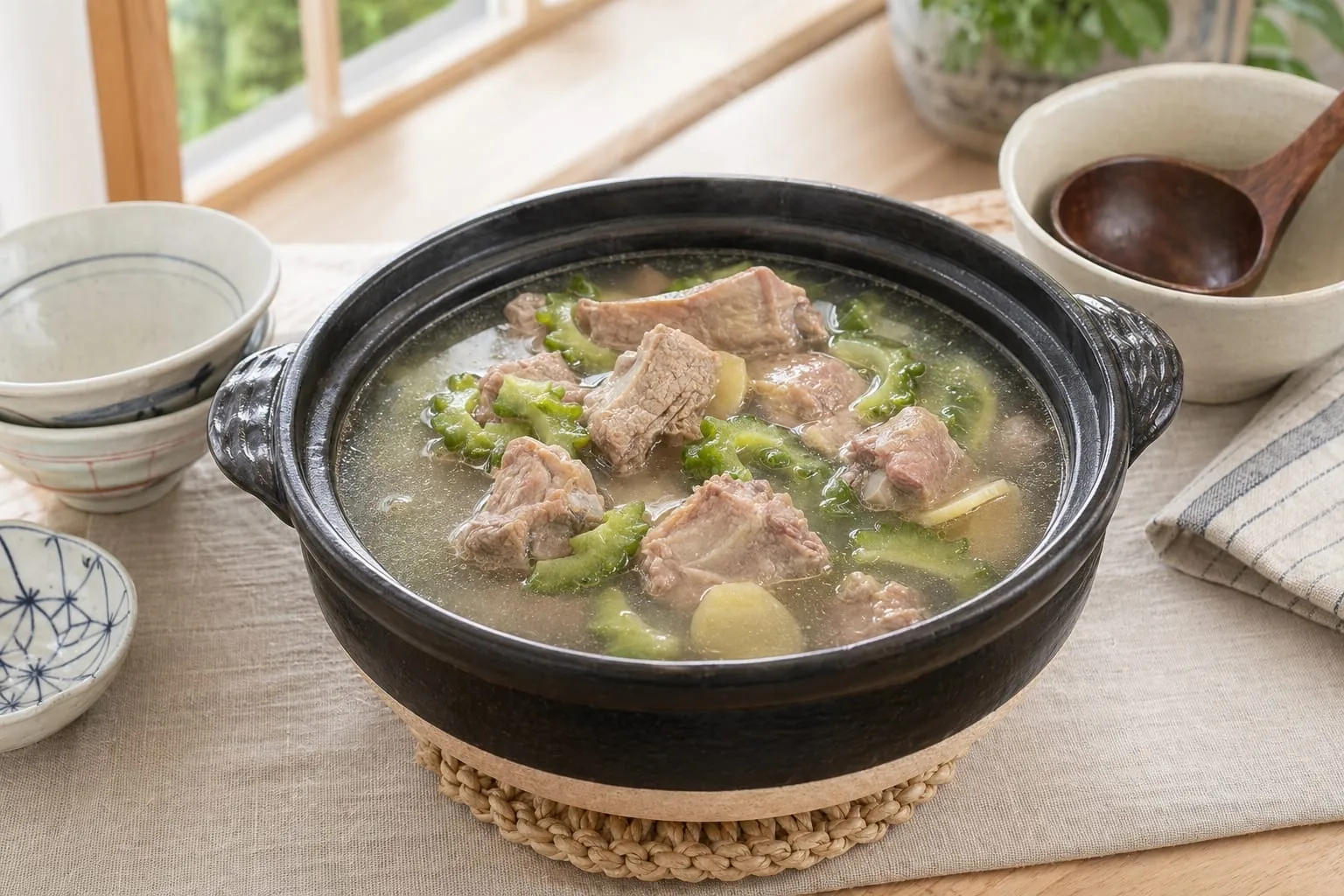
Bitter Melon Pork Rib Soup Recipe
Ready to cook? Here’s the full recipe:
Ingredients
Equipment
Method
- Place ribs in a cold water pot with 1 spring onion stalk and 2 ginger slices. Bring to a boil and blanch for 3 minutes. Drain and rinse under cold water to remove impurities.
- Halve the bitter melon lengthwise and remove the seeds. Use a spoon to scrape out as much white pith as possible (this reduces bitterness). Cut into 3 cm chunks.
- Add 1500 ml water to a pot. Add the blanched ribs, ginger, spring onion, and rice wine. Bring to a boil, then reduce to a gentle simmer for 20 minutes.
- Add the bitter melon chunks (and douchi if using). Continue to simmer over low heat for 30–40 minutes until the melon is tender and the broth is sweet and fragrant.
- Season with salt. Add goji berries and cook for 2 more minutes. Serve in bowls.
Notes
- Scrape the white pith thoroughly — it is the main source of bitterness. White bitter melon is milder than green.
- Always start ribs in cold water for blanching; this removes blood and odor effectively.
- The longer you simmer, the sweeter the broth becomes. 90 minutes makes a noticeably better soup.
- Rice cooker method: place ribs and melon in the inner pot, cover with water, cook on 2 cups outer water, then rest 30 minutes after it clicks.
- A tablespoon of fermented black beans is the traditional Taiwanese touch — adds a gentle salty depth.
Tips for Japanese Pork Ribs: No More Gamey Smell
Japanese pork ribs are excellent quality, but they can carry a slightly stronger smell than what you might be used to from Taiwanese cuts. A few simple steps make all the difference:
- Start in cold water — always: Place the ribs in a pot, cover with cold water, and bring to a boil. This draws out more blood and impurities than adding to already-boiling water. Once it boils, you’ll see grey foam rising to the surface. Drain, rinse the ribs, and clean the pot before starting the actual soup.
- Add scallion, ginger, and rice wine: When you start the soup, add a few thick slices of ginger, a knotted scallion, and a splash of rice wine (料理酒). These aromatics absorb and neutralize the gamey notes as the soup simmers.
- Simmer low and slow: After the initial boil, reduce to a gentle simmer for at least 40 minutes. Low heat keeps the broth clear and lets the flavors develop.
FAQ
Where can I buy bitter melon in Japan?
During summer (roughly June to September), most regular supermarkets in Japan carry gōyā (ゴーヤ) in the produce section. Year-round, check Asian grocery stores like Gyomu Super or Kaldi. Frozen sliced bitter melon is also available at Gyomu Super throughout the year.
The soup is too bitter — what do I do?
Make sure you’ve scraped out all the white inner membrane (not just the seeds), salted and rested the slices, and blanched them before adding to the soup. If it’s still too intense, try using less bitter melon next time, or substitute half the amount with daikon.
Can I make this in a rice cooker?
Yes! Use the soup or slow cook function if your rice cooker has one. Add all ingredients after the initial blanching of the pork ribs, then let it run for about 60–90 minutes. A pressure cooker (電気圧力鍋) is another great option and cuts the time down to around 20 minutes.
Are fermented black beans and goji berries required?
Neither is essential. Fermented black beans (dòuchǐ / 豆豉) add a savory depth and are worth trying if you can find them at a Chinese grocery store — but the soup is complete without them. Goji berries add a faint sweetness and color; optional. The core flavor comes from the pork, bitter melon, ginger, and salt.
Summer in someone else’s country has its own kind of loneliness — the heat feels different, the convenience store snacks are different, and the smell coming from a neighbor’s kitchen is nothing like home. But when you get that pot of bitter melon and pork ribs going on the stove, something shifts. The steam, the broth, that particular combination of bitter and savory — it’s a small, reliable piece of somewhere you know. Wherever you are in Japan this summer, this soup is yours to make.