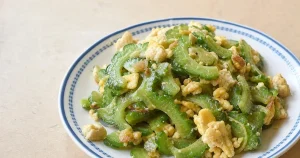
Stuffed bitter melon is one of those Taiwanese home dishes that makes summer goya feel useful instead of difficult. You hollow out thick bitter melon rings, pack them with a sticky pork-and-tofu filling, then steam, sear, or braise them until the filling turns juicy and the melon softens around the edges.
In Japan, I make it with Okinawan ゴーヤ, supermarket 豚ひき肉, firm 木綿豆腐, and 片栗粉. The important parts are simple: scrape out the white pith, mix the filling until it becomes sticky, dust the inside of each ring with starch, and cook the pieces gently so the meat does not separate.
Ingredients for stuffed bitter melon in Japan
Okinawan goya is narrower and more bitter than Taiwanese white bitter melon, but it works well once cut into thick rings. Pork gives the filling a familiar Taiwanese home flavor. Firm tofu keeps the filling softer, especially if the ground meat is lean.
| Ingredient | What to buy in Japan | Cooking adjustment |
|---|---|---|
| Bitter melon | Okinawan ゴーヤ, common in summer supermarkets | Cut into 3 cm rings; scrape the white pith well for cleaner bitterness |
| Ground pork | 豚ひき肉 | A fattier mix stays juicier; lean meat benefits from tofu |
| Ground chicken | 鶏ひき肉 | Can replace pork; add tofu or a little oil so it does not dry out |
| Firm tofu | 木綿豆腐 | Press out water before mixing so the filling does not loosen |
| Potato starch | 片栗粉 | Dust the inside of the rings lightly to help the filling cling |
| Soy sauce and cooking wine | 醤油, 料理酒 | Cooking sake can replace Taiwanese rice wine, but the aroma is softer |
If your main concern is bitterness, start with the bitter melon prep below. If the ground pork smells strong, handle it gently; do not rinse it under running water, because raw meat splash can contaminate the counter and the texture becomes loose.
How to make goya less harsh
This dish should keep a little bitterness. What you want to remove is the rough, harsh bitterness from the white pith. Cut the goya into thick rings, scoop out the seeds and white inner membrane with a spoon, rub the rings with a little salt for 10 minutes, then rinse and pat dry.
If the goya is especially bitter, blanch the rings in boiling water for about 30 seconds and cool them quickly. Do not blanch too long. If the rings become too soft, they can tear while you stuff them.
How to keep ground pork clean-tasting
For ordinary supermarket pork, grated ginger, cooking sake, white pepper, and salt are enough. Mix these into the ground pork first, stirring in one direction for 1–2 minutes until the meat becomes sticky. Then add tofu, egg, soy sauce, sesame oil, and potato starch.
Method 1: season the filling directly
For 300 g ground pork, add 1 tablespoon cooking sake, 1 teaspoon grated ginger, a little white pepper, and 1/4 teaspoon salt. Stir in one direction until tacky, then add the pressed tofu, egg, soy sauce, sesame oil, and starch. If the pork aroma is strong, add a little minced scallion white; do not add so much garlic that the dish turns into garlic meatballs.
Method 2: short ice-water soak when the smell is obvious
If the meat smells noticeably stronger, place it in ice water with a little lemon juice or a few lemon slices for only 1–2 minutes, then lift it out and press it dry very well with paper towels. Keep this short. Too much water makes the filling loose and harder to hold inside the bitter melon.
Choose ground pork that looks naturally pink and does not sit in a lot of liquid. If you are not cooking it the same day, portion and freeze it instead of letting it sit in the refrigerator overnight.
Taiwanese stuffed bitter melon recipe
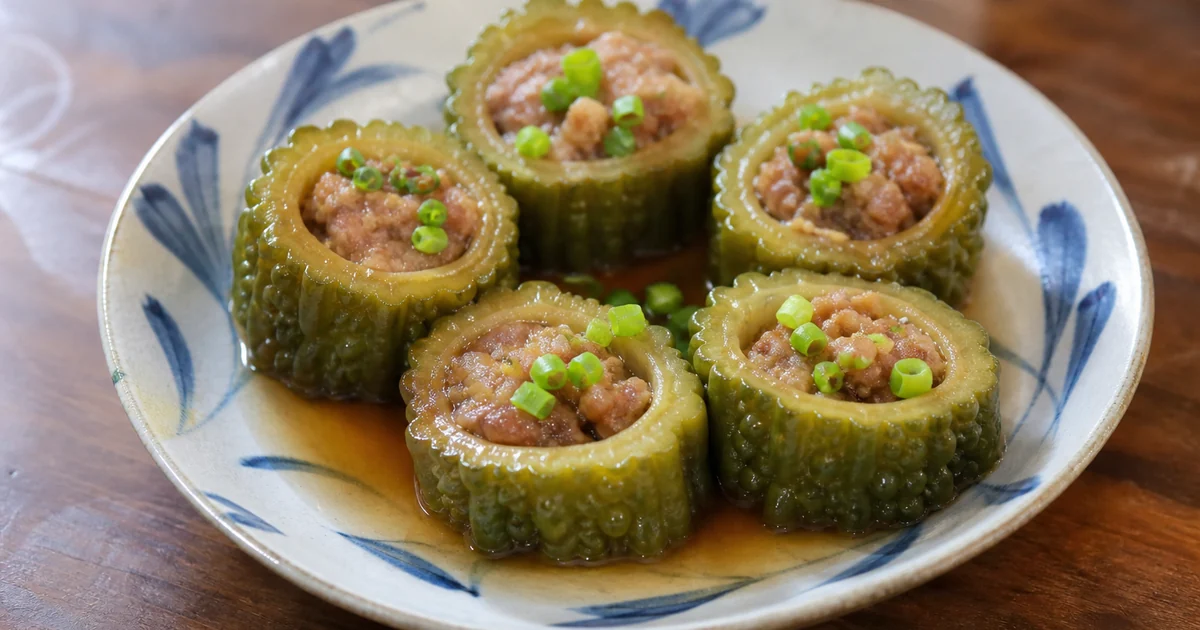
Ingredients
Method
- Wash the bitter melon and cut it into rings about 3 cm thick. Scoop out the seeds and white pith. Rub with a little salt for 10 minutes, rinse, and pat dry.
- Put the ground pork, pressed tofu, egg, soy sauce, cooking sake, grated ginger, white pepper, salt, sesame oil, and 1 tablespoon potato starch in a bowl. Stir in one direction until the filling becomes sticky.
- Dust the inside of each bitter melon ring lightly with potato starch. Pack the filling into the center and press both sides flat so the meat touches the ring firmly.
- Heat a little oil in a frying pan over medium heat. Sear both sides of the stuffed bitter melon for 1–2 minutes, just until the filling surface changes color.
- Add water or stock, soy sauce, mirin, cooking sake, and sugar. Bring to a boil, lower the heat, cover, and simmer for 15–18 minutes.
- Open the lid, spoon the sauce over the pieces, and cook 2–3 more minutes. Make sure the center of the filling is fully cooked before serving.
Notes
- Scraping the white pith well makes the bitterness cleaner.
- Press the tofu dry; wet tofu makes the filling loose.
- If the pork smells strong, season it first with cooking sake, ginger, white pepper, and salt, then mix until sticky before adding tofu and egg.
- A very short ice-water soak with a little lemon can help strong-smelling pork, but press it dry well and do not rinse ground meat under running water.
- Dusting the inner ring with potato starch lowers the chance of the filling falling out.
- For a rice-cooker version, use 1 cup water in the outer pot and rest for 10 minutes after the switch pops.
- Ground chicken can replace pork, but keep the tofu or add 1 teaspoon sesame oil so it stays moist.
How to keep the filling from falling out
The usual failure is not that the ring was underfilled. It is that the filling was not sticky, the tofu was wet, or the bitter melon surface had no grip. Think of the starch as a thin glue layer, not as a thick coating.
- Mix the filling in one direction until it turns sticky, not just evenly combined.
- Press the tofu very dry before adding it.
- Pat the goya rings dry after salting or blanching.
- Dust only the inside of each ring with a thin layer of katakuriko.
- Press the filling flat on both sides so it touches the bitter melon edge.
- Sear both sides briefly before braising if you want the most stable version.
Rice cooker, steamer, or braised version
Stuffed bitter melon can be light and steamed, saucy and braised, or hands-off in a rice cooker. I usually braise it when serving with rice, and steam it when I want the bitter melon flavor to stay cleaner.
| Method | Best for | Adjustment |
|---|---|---|
| Pan-braised | A stronger sauce for rice | Sear first, then simmer with sauce |
| Steamed | Lighter, less oily cooking | Use about half the sauce and steam 18–20 minutes |
| Rice cooker | When you do not want to watch the stove | Outer pot 1 cup water, then rest 10 minutes after it switches off |
| Soup style | A bitter melon stuffed-meat soup | Use less soy sauce, more broth, and a gentle simmer |
However you cook it, check that the center of the filling is fully cooked. Ground meat needs gentle but complete cooking, especially when the pieces are thick.
FAQ
Yes. Okinawan goya is more bitter than Taiwanese white bitter melon, so scrape out the white pith well, salt it for 10 minutes, rinse, and blanch for 30 seconds if needed. Cut it into thick 3 cm rings so it can hold the pork filling.
The filling usually falls out when the meat was not mixed until sticky, the tofu was too wet, the bitter melon ring was still wet, or no potato starch was used. Mix in one direction, dry the rings, dust the inside lightly with katakuriko, and sear before braising.
Yes. Ground chicken tastes lighter but dries out more easily. Keep the pressed firm tofu in the filling, or add 1 teaspoon sesame oil. Cook only until the center is done so the filling stays soft.
You do not have to, but searing makes the pieces more stable. Direct steaming gives a lighter flavor. If you cook it directly in soup, keep the heat at a gentle simmer so the filling does not loosen.
Yes. Arrange the stuffed rings in the inner pot with a small amount of sauce. Add 1 cup water to the outer pot, steam until the switch pops, then rest for 10 minutes. Reduce the sauce separately if you want it thicker.
Refrigerate it with the sauce for up to 2 days and reheat gently. Freezing is possible, but the bitter melon softens after thawing, so it is better for bento prep than for a crisp texture.
More Taiwanese summer cooking in Japan
Once you understand the bitterness and the filling texture, stuffed bitter melon becomes a reliable summer main dish. Serve it with rice and keep the sauce gentle. The goal is not to erase the bitterness, but to let the clean bitter edge sit beside a juicy, softly seasoned pork filling.