There’s a bowl of braised pork rice sitting somewhere in Taiwan right now — sticky, glossy, impossibly fragrant — and once you’ve tasted it, no amount of konbini onigiri will ever quite fill that particular hole.
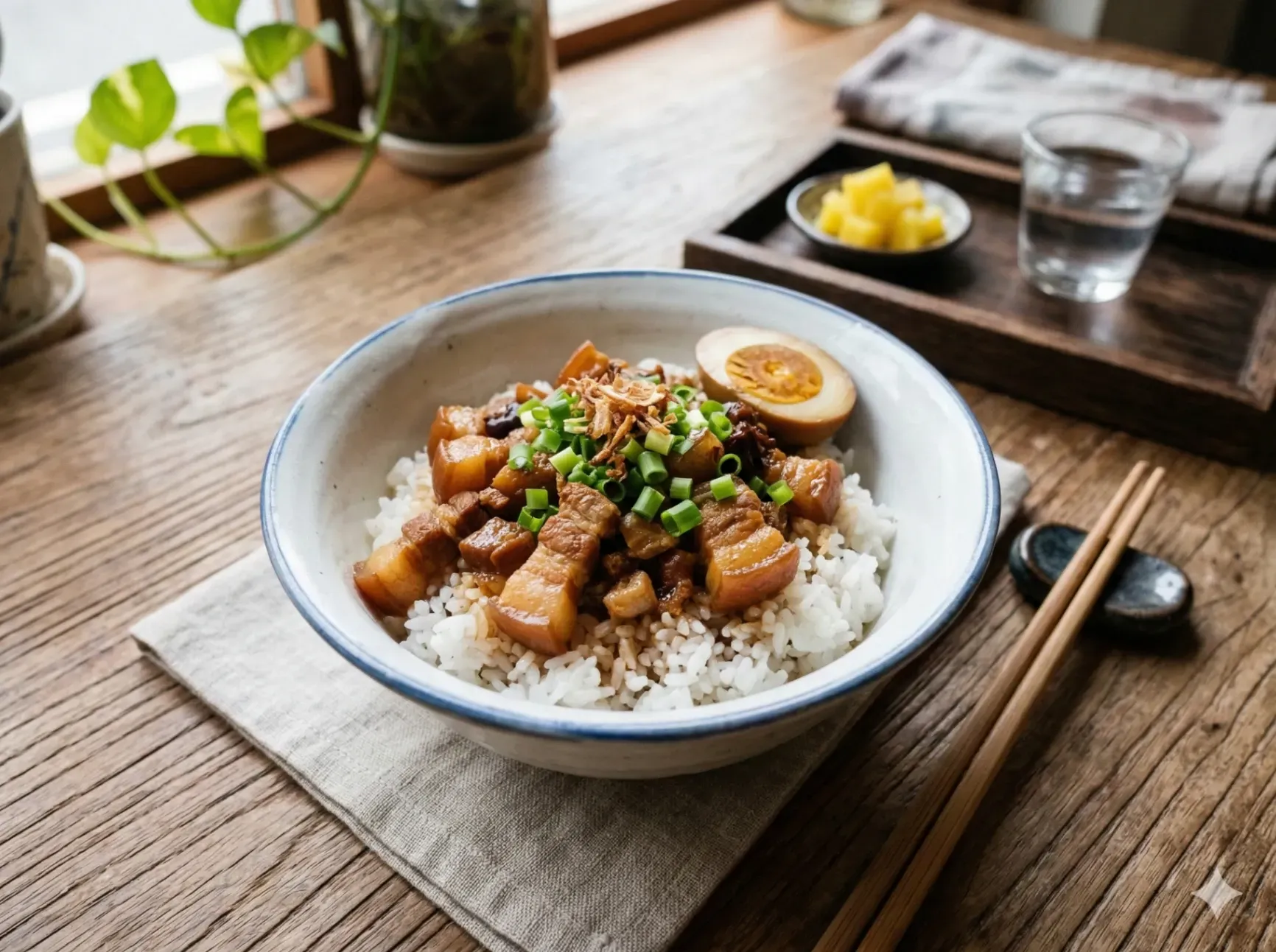
Lu Rou Fan (滷肉飯) is Taiwan’s answer to comfort food. A mountain of steamed white rice buried under slow-braised pork belly, lacquered in soy sauce and five-spice until the fat melts and the sauce turns into something close to silk. It’s the dish that Taiwanese grandmothers make without measuring anything, that night-market stalls serve for less than a dollar, and that expats living abroad dream about at 11pm on a Tuesday.
If you’re reading this from somewhere in Japan — Tokyo, Osaka, Fukuoka, or a quiet inaka town — good news: you can make this at home. And it’s going to taste exactly right.
📋 In This Article
What makes Lu Rou Fan special
On the surface, Lu Rou Fan is humble: pork, soy sauce, rice. But what happens over two hours of low, slow braising is nothing short of alchemy. The pork belly — skin on, cut into small pieces — releases its collagen into the braising liquid until the sauce thickens into a glossy, savory gravy that clings to every grain of rice.
The flavor is deep and layered: salty from soy sauce, subtly sweet from rock sugar, warmly spiced from five-spice powder and a handful of aromatics. Fried shallots are non-negotiable. They bring a caramelized, almost nutty sweetness that ties the whole dish together.
Walk into any traditional Taiwanese diner — a biandang shop, a night market stall, or a simple lunch counter — and you’ll find Lu Rou Fan on the menu. In northern Taiwan, it’s made with finely chopped pork belly. In the south, particularly Tainan, the pork is cut into larger chunks and the sauce leans slightly sweeter. The debate over which version is “authentic” is, frankly, endless — and everyone’s grandmother is winning.
The Taiwan–Japan kitchen connection
Here’s something that might surprise you: making Lu Rou Fan in Japan is easier than you’d think. Taiwan and Japan share a deep culinary history — 50 years of Japanese colonial rule left a lasting imprint on Taiwanese food culture, and the ingredient overlap between the two cuisines is remarkable.
Soy sauce (shoyu)? You have a whole aisle of it. Rice wine? Sake or mirin works beautifully in the braise. Five-spice powder is stocked at most import sections in AEON or Donki. Pork belly (buta-bara) is sold fresh at any supermarket butcher counter, often pre-sliced — though for Lu Rou Fan you’ll want to cut it yourself into small, hearty pieces.
The one ingredient that takes a little more hunting: fried shallots. They’re worth finding. Check the small-farm section at Life Supermarket (ライフ) — shallots occasionally appear there. If not, thinly sliced and slowly fried red onion makes a very decent substitute. Pre-fried shallots in bags are also available at Chinese grocery stores in most major cities.
Rock sugar and five-spice are your only potential imports — both easy to find at Kaldi, Yamaya, or any Chinese grocery. Once you have those, you’re fully equipped.
Homesick in a bowl
There’s a particular kind of craving that hits expats on rainy Sunday evenings. It’s not just hunger — it’s the specific ache for a flavor that belongs somewhere else, a smell that means home in some language your body speaks but your mouth can’t quite translate.
For Taiwanese people living in Japan, that smell is often Lu Rou Fan. The moment the braising liquid hits the hot pan and the soy sauce starts to caramelize — windows fogging up, the whole apartment filling with five-spice and rendered pork fat — something settles in the chest.
And here’s the thing non-Taiwanese cooks often discover by accident: Lu Rou Fan is even better the next day. The sauce deepens overnight in the fridge, the flavors meld, and the fat solidifies in a layer you can skim off (or leave, we won’t judge). Reheat gently, spoon over fresh rice, add a soft-boiled egg braised in the same liquid — and you have something arguably better than what you made the night before.
Make a big batch on Saturday. Eat it for the rest of the week. That’s not laziness — that’s wisdom.
Make your own Lu Rou Fan
Ready to braise? The recipe below walks you through every step — from rendering the pork to achieving that deep, lacquered sauce. Don’t rush the braise. Low heat and patience are the whole secret.
Ingredients
Equipment
Method
- Heat a splash of oil in a wok over low heat. Add sliced shallots and fry slowly, stirring occasionally, until golden brown and crispy — about 8–10 minutes. Remove and set aside.
- Increase heat to medium. Add pork belly cubes and cook until lightly browned on all sides. Add crushed garlic and ginger slices, stir for 1 minute until fragrant.
- Add soy sauce, thick soy sauce, rice wine, sugar, five-spice powder, and white pepper. Stir well to coat the pork evenly.
- Add water and the fried shallots. Bring to a boil, then reduce to low heat, cover with a lid, and simmer 60–80 minutes until the pork is very tender. If using soy-braised eggs, add them after 30 minutes.
- Remove lid and increase heat briefly to reduce the sauce until glossy and slightly thickened. Taste and adjust seasoning. Spoon generously over steamed rice and serve with a braised egg.
Notes
- Shallots are the soul of Lu Rou Fan — fry until truly golden.
- The longer you braise, the more melt-in-your-mouth the pork becomes. 90 min = silkier result.
- Leftovers taste even better the next day. Freeze in portions.
- No thick soy sauce? Use 1 tbsp oyster sauce instead.
- Rice cooker method: run the cook cycle twice (4 cups outer water total).
Once you’ve made Lu Rou Fan once, it enters your regular rotation. It’s the kind of recipe that scales up effortlessly for guests, travels well in a thermos for a work lunch, and rewards you more the longer it sits. Taiwan’s comfort food has been hiding in your Japanese kitchen all along — you just needed an excuse to make it.
If you make this, we’d love to see it. Tag @shinracooking and tell us how it turned out.